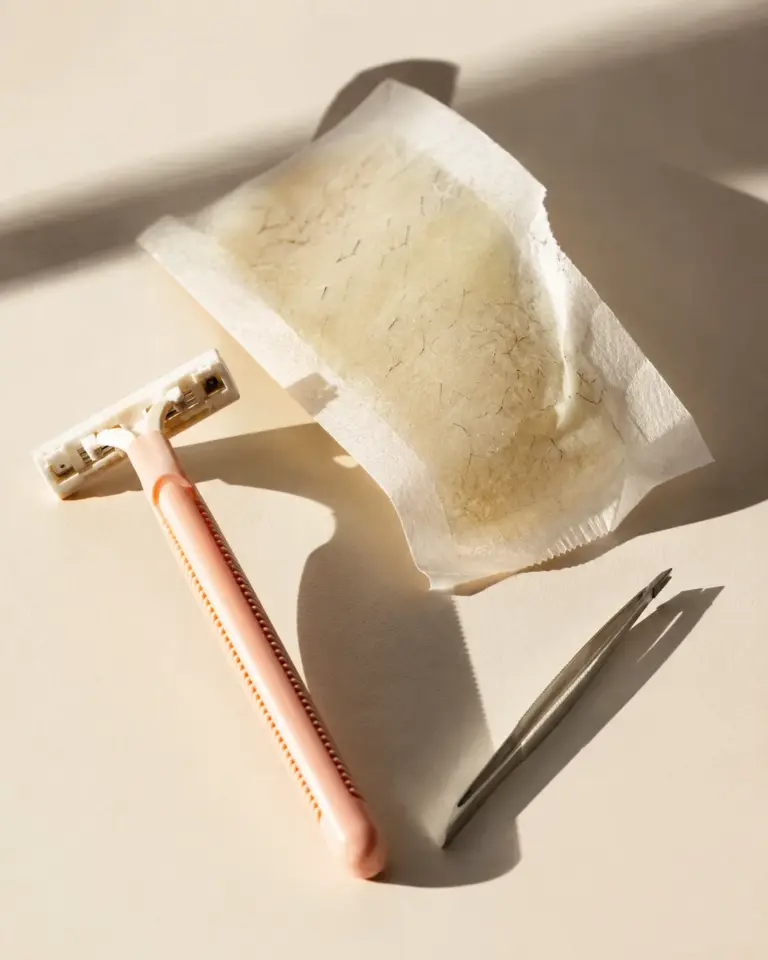

The short answer: the three big myths — “it hurts terribly”, “it only suits light skin” and “one treatment is enough forever” — all come from an earlier generation of devices. Below is each myth and what is actually true — including what laser genuinely does not do.
Does laser hair removal hurt, is it safe, does it suit everyone
“It hurts terribly”
This myth was born in a generation of devices that worked with one strong pulse. SHR technology delivers the same energy in many short low-intensity pulses, and the cooling head keeps the surface of the skin cold throughout the pass. In sensitive areas the sensation is stronger, and you can always stop.
“It only suits light skin and dark hair”
What decides it is the contrast between the hair colour and the skin tone, not the tone alone. The 1064 nm wavelength is absorbed least by the melanin of the upper skin layer, and together with the continuous cooling it makes darker tones treatable too. More in how laser hair removal works.
“It causes burns”
The risk of a burn rises when an intensity is used that does not suit the skin, and that is exactly what the assessment is for. We scan the skin with a dermatoscope before setting the intensity — and that is what separates one place from another more than the device itself.
Results and expectations
“One treatment is enough forever”
The laser affects hairs in the active growth phase, and at any given moment only some of the hairs are there. So it takes a series: about 12 treatments in three stages.
“The result is temporary” — and what laser really does
Here it is worth being precise, because many places exaggerate in both directions. Laser permanently reduces the amount of hair and its thickness — that is not a result that disappears. But it does not erase hair forever: after the series, occasional maintenance treatments are needed. Anyone promising you complete removal forever is selling you something they do not have.
“It does not work on light or vellus hair”
Partly true. White hair does not respond — it has no melanin to absorb the energy. For light hair the answer depends on the contrast against the skin, so it is decided at the assessment and not over the phone. We would rather say that in advance than after you have bought a series.
Timing and areas
“You must not have laser in the summer”
You can, in summer too. The limitation is on a fresh tan, not on the season. We put it this way: tanned is not a problem, burnt is. As a general guide — about three to four days after sun exposure, and after a burn until the peeling has passed.
“It does not suit every area of the body”
The device comes with interchangeable heads in different sizes, including a small head for facial and delicate areas. What you need to check is not “which areas” but whether the operator knows how to adapt the intensity to each area separately. More in the face guide.
“It does not suit sensitive skin or acne”
These are checked at the assessment. What matters is that you tell us in advance: regular medication, recent skin treatments on the area, and pregnancy or breastfeeding — in both of those we do not treat.
What is worth checking before you start
Instead of trying to settle myths on the internet, there are four questions that answer most of the worries: what technology you are facing, who operates it, how they price, and what is checked at the assessment before the first treatment.
The preparation itself is gathered in the preparation guide, and the days afterwards in what to do after a treatment. For prices — the full price list and the price calculator.
Questions that keep coming up
If laser is not forever, why do it at all?
Because the reduction is permanent and significant. After a series there is little hair left and it is finer, and maintenance is once every few months instead of twice a week. That is the difference between managing a subject and dealing with it all the time.
What is the difference between SHR and IPL?
IPL is not a laser but broad-spectrum light from a lamp, so its energy is less focused. SHR is a delivery method — many short low-intensity pulses during continuous motion — and our device is a diode platform with four wavelengths.
How long does the result hold without maintenance?
It varies from person to person and is also affected by hormonal factors. That is why we talk about occasional maintenance rather than an expiry date, and set it by what we actually see.
The safe way to check what is true for you – a free trial: a dermatoscope scan, an explanation of what we see, and a short pass on your own skin.